Search
140 results for “Vanagon”
A small radiator that transfers heat from engine coolant to air for the cabin heating system. Vanagons may have front and additional rear heat exchangers, depending on equipment and market.
A refrigerator installed as part of a camper interior. The documented Vanagon Westfalia appliance supports gas and electric operation; exact power sources and operating requirements depend on the refrigerator model and its manual.
The front-mounted heat exchanger in a water-cooled Vanagon's engine-coolant circuit. It releases heat from circulating coolant to outside air. Air-cooled Type 2 buses do not use an engine-coolant radiator.
The belt-driven pump that circulates engine coolant through the water-cooled Vanagon engine and cooling circuit. It is different from the small electric pump used to deliver water to a camper sink.
( Constant Velocity Joint ) One of the small circular devices at an end of an axle on a bus . Buses , Vanagons , and EuroVans have four of these, while the Syncro Vanagons have a total of eight. These are necessary to allow the axle to move up and down while still turning to propel the car. the joints need to be keep greased to function properly. when they are worn, they make a knocking-noise that strikes fear into the hearts of bus owners everywhere. Microbuses do not have CV joints, but use a 'swing-axle' and reduction gear box instead.
A heat exchanger that removes heat from engine oil. Air-cooled Type 2 engines use an oil cooler in the engine cooling assembly; design and mounting vary by engine. It is distinct from a Vanagon coolant radiator.
The pressurized tank in the water-cooled Vanagon cooling circuit that accommodates coolant expansion and provides a fill and bleed point. It is separate from the low-pressure coolant refill reservoir; the names are sometimes confused in parts listings.
The accessible coolant container used to replenish the water-cooled Vanagon system as coolant moves between the pressurized expansion tank and the reservoir. It is not the pressurized expansion tank itself; verify the part by the vehicle's cooling-system layout.
The 12-volt battery supply used for camper electrical loads such as interior lighting, the water pump, and controls on the documented Vanagon Westfalia. Whether a particular vehicle has a separate auxiliary battery depends on its model and later modifications.
The housing around the engine cooling fan that directs airflow across the cylinders and cylinder heads on an air-cooled VW engine. Type 2 shrouds differ by engine and model year; this term does not describe the liquid-coolant radiator used on water-cooled Vanagons.
Any Volkswagen Transporter from 1949 to 1967, characterized by a split (two-piece) windshield and rounded body contours. all were powered by beetle Type 1 engines and all had 'reduction gears' on the half-axles. known also as T1 Transporters . This term is also used by VW SA for the present 5 Cyl. (Vanagon-style) van without exclusive options.
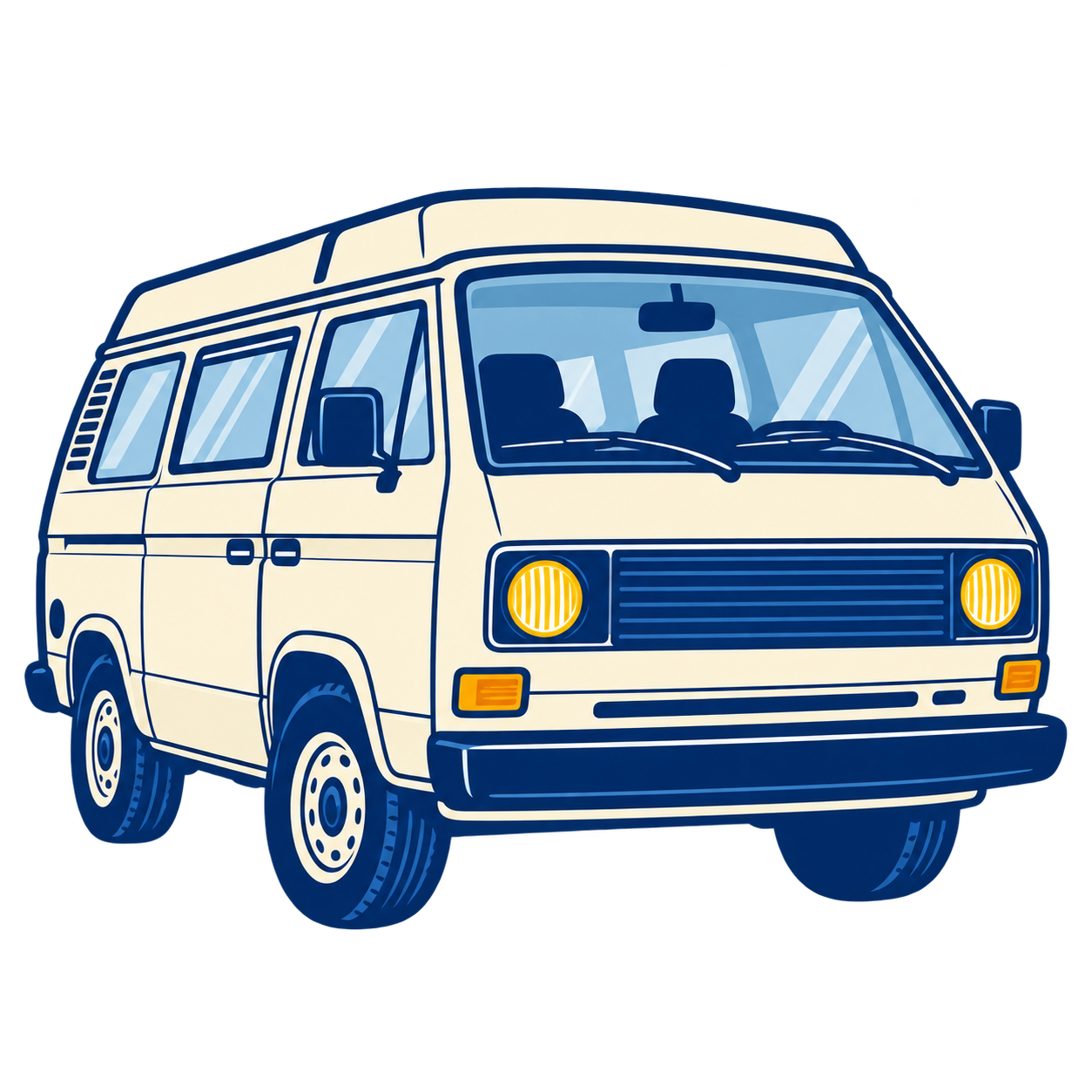
The four-wheel drive version of the Vanagon , made between 1986 and 1991. using a viscous coupling arrangement, the front wheels could be made to automatically provide pulling power (at any time the rear wheels began to slip or spin). This term also applies to the four-wheel drive EuroVans , which are unfortunately not imported into the United States.
Anti-Locking Braking System. a computerized method of helping to prevent wheel skid/lock-up during braking. it does not prevent spins, nor does it allow you to stop in a shorter distance. it does allow you to steer the car while braking as hard as possible. available as an option on some Vanagons and EuroVans in Europe during the late 1980's-1990's.
An engine that circulates liquid coolant through passages and a radiator to carry heat away. Gerry’s Vanagon spark-plug reference lists DH water-cooled engines with Digijet for 1983–1985 and MV engines with Digifant for 1986–1991. Verify engine code, market, and model year; this archived table is an identification aid, not a complete application chart.
Vehicle Identification Number. This is a number that uniquely identifies your vehicle. It is usually located in several locations on the vehicle, the most common being under the windscreen just forward of the driver (and intended to be viewed from the outside of the bus.) You'll also find the VIN on the frame rail under the van near the front edge of the sliding door. Also see: Table for interpretting the Vanagon VIN
Adventurewagen was a Fort Bragg, California conversion builder, not a Volkswagen model or Transporter generation. In a December 1998 Gerry thread about camper conversions, a contributor describes its high-roof conversion as common on the U.S. West Coast and distinguishes that fixed high roof from pop-top layouts. A 2001 thread also identifies Adventurewagen as a maker of Vanagon high-top conversions. Roof, interior, and equipment vary by build and vehicle year.
An accessory package originally available on the Vanagon that bridged the gap between the passenger van and the camping-oriented Westfalia model. With the included rear bench that folded into a double-bed, fold-out table, and privacy curtains, an owner could easily move seven people during the week and provide sleeping space for two on the weekends. This idea and name have just been reintroduced as a model of the revamped Eurovan called the MV Weekender .
Community name for Volkswagen’s water-cooled, horizontally opposed four-cylinder engine family used in Vanagons. Gerry’s technical index covers 1.9 L and 2.1 L versions and year-specific service topics. A January 2004 archive thread describes an owner’s 1983 1.9 L Waterboxer running roughly when cold but normally after warming up; it records the symptom and discussion, not a universal cause or fix. Identify the engine code and model year before using parts or service information.
The electronic control unit (ECU) is part of Volkswagen’s Digifant fuel-injection and engine-management system. Gerry’s 1986–1991 technical bulletin index distinguishes these applications from the earlier Digijet years. In a January 1999 list thread, an owner of a 1986 Westfalia reported that the engine quit after cooling-system bleeding and asked whether fuel starvation or a failed Digifant component was involved; the thread records a troubleshooting question, not a confirmed diagnosis. Check engine code and market before identifying an ECU.
In Gerry’s preserved FAQ alignment article, “Camper model” refers to the heavier Vanagon Syncro camper configuration, with separate alignment values from lighter non-camper vehicles. A Gerry discussion on 15 October 2003 about the “official” Syncro alignment specs quotes the chart for 1986–1991 Syncro campers with dual batteries up front; a 1999 thread separately asks about an almost-empty 1986 Syncro. These historical sources show why the exact load and configuration matter, not a current alignment specification. Use service data for the specific vehicle.
Gerry community context
Related mailing-list messages and current discussions from Gerry. These are community context for the dictionary term.
Gerry search is temporarily unavailable. You can try the full archive search.
Search Gerry for “Vanagon”