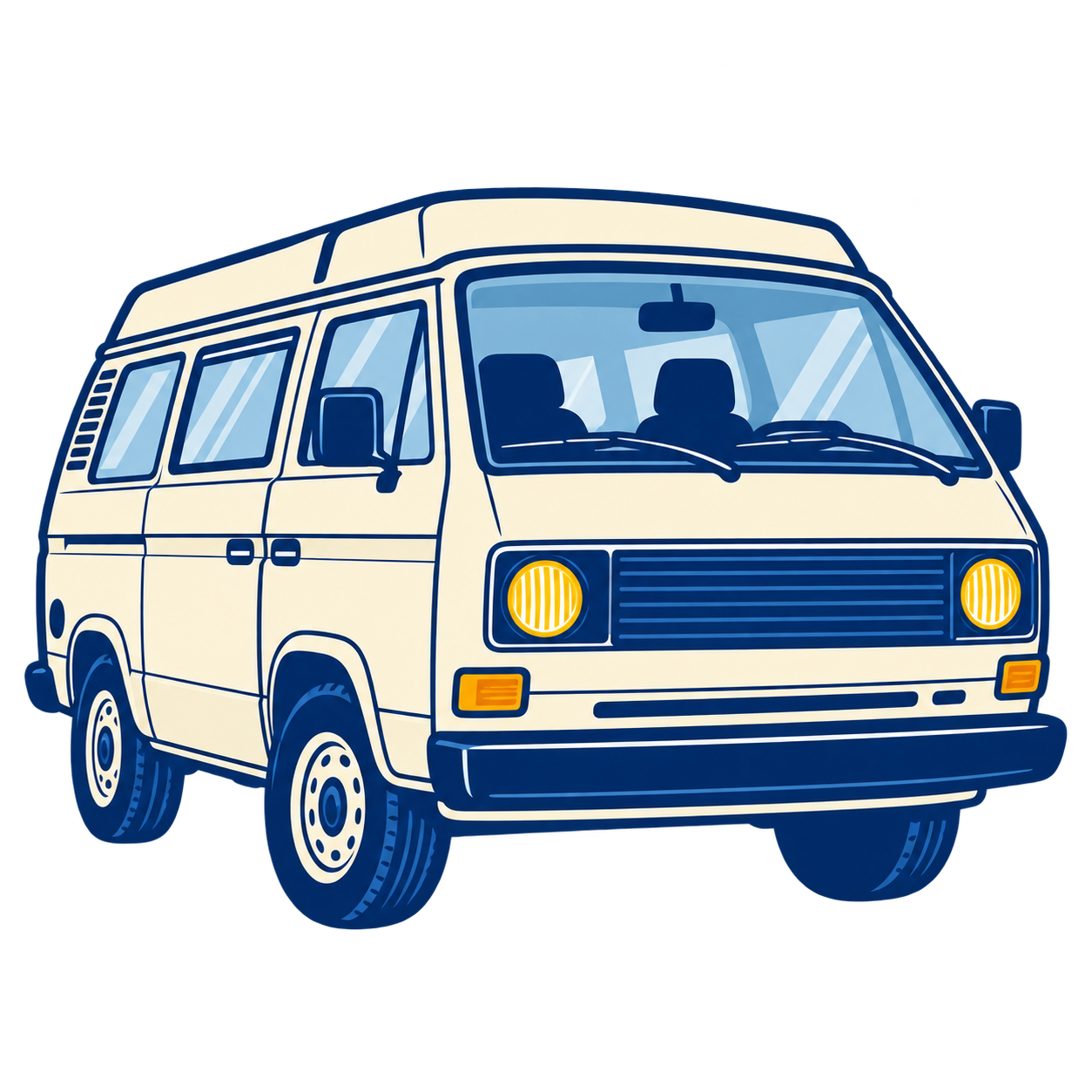
Explore the Vanagon dictionary.
Explore the original Vanagon.com bus terminology and mailing-list slang, preserved with source links and clearly labeled translations.
1,503 definitions
Any Volkswagen Transporter from 1949 to 1967, characterized by a split (two-piece) windshield and rounded body contours. all were powered by beetle Type 1 engines and all had 'reduction gears' on the half-axles. known also as T1 Transporters . This term is also used by VW SA for the present 5 Cyl. (Vanagon-style) van without exclusive options.
Vehicle Identification Number. This is a number that uniquely identifies your vehicle. It is usually located in several locations on the vehicle, the most common being under the windscreen just forward of the driver (and intended to be viewed from the outside of the bus.) You'll also find the VIN on the frame rail under the van near the front edge of the sliding door. Also see: Table for interpretting the Vanagon VIN
Another name for Double-cab pickup trucks.
Fahrvergnügen is a made-up German word meaning 'pleasure of driving', and Volkswagen marketting claims it can only be experienced in a VW automobile.
Liters per 100 Kilometers. a measurement of fuel economy in the metric system. note that this is exactly backwards from the American system of miles/gallon. the metric measurement denotes the amount of fuel required to go a certain distance roughly, 10 L/100km = 23.5 mpg.
A model of bus that contained interior features such as a bed, stove, cabinets, and in some versions, a refrigerator. some versions had a pop-up roof to allow extra room, ventilation, and sleeping room 'upstairs'. Some of the many companies making campers are Westfalia , Winnebago , Devon , Country Homes, Dormobile , and TRAKKA .
The first generation of Transporters , from 1949-1967. Note that this is not Type 1, but just T1 (for Transporter 1 ). Strictly speaking, it should be Type 2 , T1 . Known as the Station Wagon or Microbus .
Another name, usually British, for the Vanagon body series.
A type of rear axle that is 'fixed' at the wheel (that is, it is not able to flex up or down), but is able to move up and down at the transmission end. It required the rear wheels to move in an arc, rather than vertically, when hitting bumps. in some cars (beetles and corvairs and some early porsches), it could cause the wheel to tuck under the car during high speed cornering.
Buses made before mid-1955, whose major characteristics are the oversized engine lid and the lack of a rear cargo hatch. These also did not have the ventilation eyebrow above the windshield/windscreen.